
There’s a moment every EV owner remembers: that first quiet glide forward, the instant torque that presses you into your seat, the almost sci-fi feeling of moving without a single drop of fuel. The electric vehicle revolution feels exciting, hopeful, even. Cleaner air, fewer emissions, smarter mobility.
What’s not to love?
But here’s the real question most people don’t ask: What if an electric car’s sustainability isn’t defined only by the electricity that charges it, but by every material, process, and design decision that brings it to life?
Because an EV is much more than a battery on wheels. It’s thousands of parts sourced, formed, assembled, used, repaired, and eventually retired. If we truly want green transportation, we must look beyond the plug.
This is where the story gets interesting.
In this article, we’re peeling back the sheet metal to explore sustainable electric vehicle design in its fullest sense, from the earliest sketches to end-of-life recovery. We’ll talk about materials, batteries, energy efficiency, and the circular systems that make tomorrow’s vehicles cleaner than ever.
Grab your coffee. Let’s dive into the real engineering, and the thoughtful design choices, shaping the next generation of electric vehicles.
The Foundation – Rethinking the EV Life Cycle
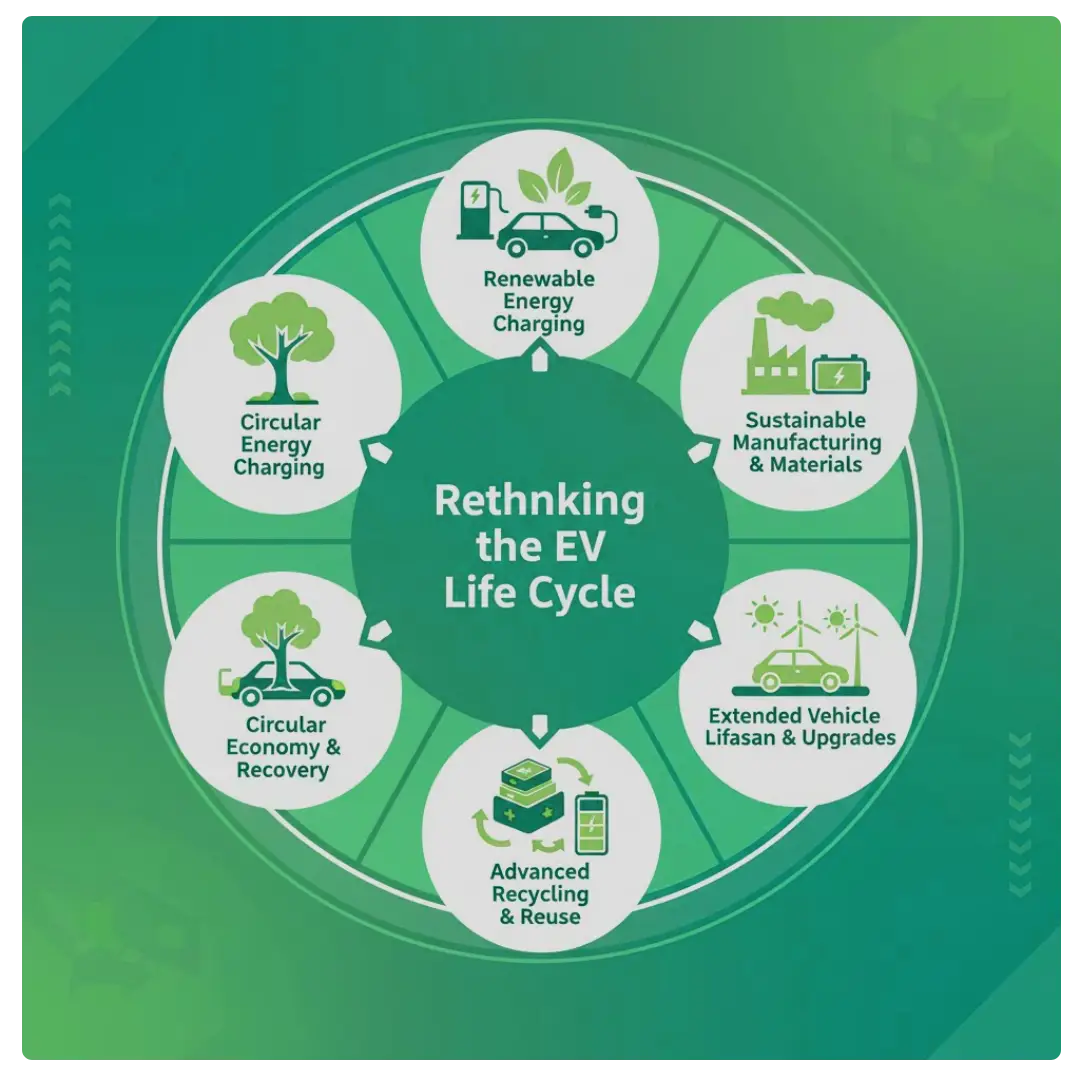
When most people think of sustainability in electric vehicles, they picture the moment an EV rolls quietly down the street, no tailpipe, no emissions, just clean motion. But if we zoom out, sustainability becomes a much bigger story. To design responsibly, we have to look at the entire electric vehicle life cycle, not just the part we see on the road.
For decades, the auto industry followed a simple, linear path:
Make → Use → Trash.
It worked fine when cars were fewer and materials seemed infinite. Today, it’s a recipe for waste, pollution, and massive resource consumption.
Sustainable electric vehicle design flips this thinking on its head. Instead of a straight line, we shift to a circle, a loop where every material, component, and design decision has a future purpose.
Cradle-to-Grave vs. Cradle-to-Cradle
Cradle-to-grave is the traditional model: raw materials come in, a car is built, it’s used for a decade or two, and then the remains head to junkyards or landfills.
Cradle-to-cradle is the future-thinking model:
- Materials come from responsible, renewable, or recycled sources
- Components are designed to be repaired or upgraded
- End-of-life parts are recovered and fed back into production
Instead of “Where do we throw this away?” designers ask,
“How do we make sure nothing becomes waste?”
The Four Key Phases of a Truly Sustainable EV Life Cycle
1. Material Sourcing
This is where the sustainability story begins.
Where do the metals, plastics, fibers, and chemicals come from? How much energy is required to obtain them? Are they recycled? Renewable? Ethically mined?
Sustainable electric vehicle design requires that we think about origins, because the cleanest product is one that starts clean.
2. Manufacturing & Assembly
Even electric cars can have a dirty beginning if factories rely on fossil fuels or high-waste production processes.
Designers now work hand in hand with engineers to:
- Reduce the number of parts
- Use modular components
- Optimize assembly to cut waste
- Shift factories toward renewable energy
Every bolt, weld, and stamped panel impacts the vehicle’s carbon footprint long before it hits the road.
3. Useful Life
An EV’s operational phase is where the benefits shine: zero tailpipe emissions, higher efficiency, quiet operation. But sustainability doesn’t end there.
Designers influence how long a vehicle lasts through:
- Durable materials
- Intuitive layouts
- Repair-friendly architecture
- Smart battery management systems
A product that lasts longer, and performs efficiently, is inherently greener.
4. End-of-Life Recovery
Traditionally, old cars get crushed and scrapped.
But a future-proof electric vehicle is designed with its rebirth in mind.
That means:
- Identifiable materials
- Easy disassembly
- Recyclable components
- Recoverable metals, plastics, and battery materials
In short, every vehicle becomes raw material for the next generation.
The Materials – What Are Our Cars Really Made Of?
If you’ve ever stepped into a modern electric vehicle, you’ve probably noticed something: it doesn’t feel like the cars we grew up with. The materials are different. Softer. Lighter. More natural. Sometimes even, plant-based.
That’s because the move toward sustainable electric vehicle design starts long before batteries or motors come into the picture. It begins with the very stuff cars are made of.
For over a century, cars relied heavily on plastics, leather, and steel, not exactly the most planet-friendly ingredients. But today, designers and engineers are pushing for a radically different palette of materials, one that reduces environmental impact without sacrificing performance or comfort.
Let’s take a closer look at how the industry is rethinking the physical building blocks of the EV.
Beyond Leather and Plastic: The Rise of New Interior Materials
Car interiors are undergoing one of the biggest eco-friendly transformations, especially in EVs where sustainability is core to the brand story.
Vegan, Plant-Based Leathers
Forget petroleum-based faux leather. We’re seeing high-quality alternatives made from:
- Pineapple leaves (Piñatex)
- Mushrooms (mycelium-based leather)
- Cactus fibers
- Apple peels and other fruit waste
These materials don’t just reduce emissions, they feel premium and are surprisingly durable. Imagine sliding into a seat that’s soft, breathable, and grown instead of manufactured. That’s where eco-friendly EV manufacturing is headed.
Recycled Plastics With a Purpose
Recycled plastics used to mean cheap, grainy, or flimsy. Not anymore.
Modern processes allow manufacturers to turn ocean plastics, bottles, and post-consumer waste into:
- Dashboards
- Door panels
- Seat fabrics
- Interior trims
They’re refined, stylish, and offer a second life to materials that would otherwise pollute our planet.
Nature-Inspired Structural Materials
Interiors are only part of the story. Even the structure of electric vehicles is changing.
Flax, Hemp, and Bamboo Panels
Natural fibers are quickly replacing petroleum-heavy composites. These bio-based materials are:
- Lightweight (better efficiency)
- Strong
- Renewable
- Low-carbon during production
For example, a door panel reinforced with hemp can be lighter and more energy-efficient to produce than a traditional plastic panel.
The Bodywork: Aluminum, Recycled Steel & Green Metals
To improve efficiency, EVs need to be lighter. One of the biggest shifts has been in external body materials.
Recycled Steel
Still widely used, but increasingly sourced from high-quality recycling streams. The energy demand for recycled steel is far lower than producing new steel from ore.
Aluminum
EVs are using more aluminum because it’s lightweight and corrosion-resistant. But traditional aluminum production is energy-intensive. That’s why the industry is exploring:
- Green aluminum, created using renewable-powered smelters
- Closed-loop aluminum recycling, where factory offcuts are melted and reused onsite
Every kilogram saved in body weight adds range, reduces battery load, and cuts emissions.
The Tire Challenge: Reinventing an Overlooked Component
Tires are a sustainability headache, full of rubber, fillers, chemicals, and fabrics that are notoriously hard to recycle.
But innovation is happening fast.
Sustainable Rubber Alternatives
Researchers are developing rubber from unconventional sources like:
- Dandelions
- Guayule plants
- Bio-based polymers
These reduce reliance on traditional rubber plantations, which often contribute to deforestation.
Low-Microplastic Tires
A surprising fact: tires are one of the world’s biggest sources of microplastic pollution.
Designers are now creating tread patterns and rubber compounds that shed fewer particles during use.
The Power of Smart Material Design
This is where sustainability and creativity blend. When designers choose materials, they’re not just picking what looks good, they’re shaping the car’s weight, recyclability, durability, and environmental footprint.
Imagine seats upholstered in a soft, durable material derived from mushrooms, door trims made from woven flax fibers, and exterior panels crafted from green aluminum powered by solar energy.
This isn’t a futuristic concept; it’s already happening.
Every material choice adds up to a cleaner electric vehicle life cycle, and gives sustainable materials for cars a whole new meaning.
The Heart of the Matter – Designing a Greener Battery
If the electric motor is the muscle of an EV, the battery is undeniably its heart. It’s the most valuable component, the heaviest component, and, let’s be honest, the most controversial one. People celebrate EVs for having zero tailpipe emissions, but then ask: “What about the battery?”
That question is valid. Batteries contain metals that require significant energy to extract, and if they’re not handled responsibly at the end of their life, they can create waste or environmental harm. But this is where sustainable electric vehicle design shines, because the industry is finally approaching EV batteries with a full life-cycle mindset rather than a “use it and hope for the best” attitude.
A greener battery isn’t just about chemistry, it’s about design decisions made at every stage of its life.
Responsible Sourcing: Better Ingredients for Better Batteries
The shift toward sustainability starts at the mining stage. Traditional batteries used cobalt-heavy chemistries, but cobalt mining has well-documented ethical and environmental concerns. Today’s innovations focus on reducing or eliminating cobalt altogether.
Cobalt-Free Chemistries (like LFP)
Lithium iron phosphate (LFP) batteries are becoming more popular because they:
- Use no cobalt
- Last longer in daily cycling
- Are more stable and safer
Other battery types are experimenting with even more abundant materials like sodium, which could dramatically lower environmental impact.
Ethical, Traceable Mineral Supply Chains
Manufacturers are now using blockchain or geological tracing methods to verify that:
- Lithium is ethically sourced
- Nickel comes from responsible mines
- Recycling streams supplement new materials
Sustainable battery design begins with choosing the right ingredients, just like a good recipe.
Longevity by Design: Making Batteries Last Longer
A greener battery is one that lasts as long as possible.
Designers and engineers are working together to make EV batteries tougher, smarter, and more repairable.
Thermal Management Systems
Batteries hate extreme heat or cold. Intelligent cooling systems, liquid cooling, phase-change materials, heat pumps, help maintain the perfect temperature, reducing wear and extending life.
Smart Charging & Software Optimization
Charging software limits degradation by:
- Managing charge rates
- Reducing stress during fast charging
- Learning user behavior to optimize cycles
It’s a bit like teaching a phone battery good habits from day one.
Structural Integration
Some EVs now integrate the battery into the vehicle’s frame. This reduces weight, increases rigidity, and in many cases allows for fewer, larger cells that are easier to manage and cool.
When a battery lasts longer, the entire electric vehicle life cycle becomes significantly more sustainable.
The Second Life: Batteries That Keep Giving
When an EV battery reaches 70–80% of its original capacity, it may no longer deliver optimal driving range, but it’s far from useless.
This is where the concept of second-life energy storage comes in.
These “retired” EV batteries can be converted into:
- Home energy storage units
- Backup power systems
- Solar farm storage
- Grid-balancing solutions
Think of it as retiring from full-time athletic work to take on a less demanding desk job.
The battery still contributes to sustainability, just in a different role.
Closing the Loop: Designing Batteries for Easy Recycling
This is where EV battery recycling becomes essential, not as an afterthought, but as a core design principle.
Modern recycling methods, especially hydrometallurgical processes, can recover:
- Up to 95% of lithium
- Nearly all nickel
- Nearly all cobalt
- Copper, aluminum, and manganese
But here’s the catch:
We can only recycle well if batteries are designed to be taken apart.
Designing for Disassembly
Instead of glued-together packs that are impossible to open safely, next-generation batteries include:
- Modular cell structures
- Accessible fasteners
- Clear material labeling
- Fewer adhesive layers
It’s like designing a Lego set with instructions for taking it apart, simple, logical, and ready to reuse.
This approach closes the loop, turning old batteries into raw material for new ones. And that’s not just sustainable, it’s efficient and economically smart.
The Big Picture – Efficiency and the Circular Economy
Zoom out far enough, and sustainable electric vehicle design becomes more than the sum of its parts. Yes, materials matter. Yes, battery life cycles matter. But when you step back, something bigger emerges, a philosophy that shapes every curve, connection, and component. This is where energy efficiency and the circular economy come together to define the true future of green transportation design.
EVs don’t just need to be clean; they need to be clever. And good design plays a starring role.
Slippery Shapes: Why Aerodynamics = Sustainability
One of the simplest ways to make an EV greener is to help it glide through the air with minimal resistance.
A more aerodynamic shape means the motor works less, the battery lasts longer, and the car requires fewer resources to deliver the same performance.
Here’s a relatable way to think about it:
Walking through a strong wind takes more effort than strolling on a calm day. Cars feel “wind resistance” every second they move. Streamlined designs let the car cut through air like a well-honed blade instead of fighting against it like a brick.
This is why modern EVs often have:
- Smooth underbodies
- Flush door handles
- Softly curved body panels
- Narrow grilles or none at all
- Tapered rear ends to reduce turbulence
Better aerodynamics = less energy used per mile = fewer emissions from electricity generation.
The most sustainable kilowatt-hour is the one the car never needs to consume.
The Circular EV: Designing With the End in Mind
Now let’s revisit the electric vehicle life cycle and imagine it as a perfect loop, not a straight line.
This loop is the heart of circular economy electric vehicles, where nothing is wasted, and everything has a future purpose.
A circular EV is designed to:
- Be easily repaired (so parts don’t go to waste)
- Be upgradable (so technology outlives the initial model)
- Be modular (so components can be replaced individually)
- Be disassembled cleanly (so materials can be recovered efficiently)
Picture a car where the battery slides out like a drawer, where wiring harnesses click apart like puzzle pieces, and where every material is clearly labeled for recycling. That’s the dream designers are working toward.
This shift isn’t just about reducing waste, it’s about honoring the value of every atom that goes into the vehicle. A circular EV respects the planet by keeping materials in motion, not in landfills.
Bottom Line
When we step back and look at the full picture, one thing becomes clear: the future of sustainable electric vehicle design isn’t defined by a single innovation. It’s the harmony of many thoughtful choices, materials that respect the earth, batteries built for long and meaningful lives, aerodynamic shapes that sip energy instead of guzzling it, and circular systems that ensure nothing truly goes to waste.
The EV revolution is more than electric motors and silent acceleration. It’s a design revolution. A shift toward asking better questions:
Where did this come from? How long will it last? What happens after its final mile?
These questions, simple but profound, are shaping the next generation of green transportation.
And the exciting part? We’re still just getting started. The road ahead will be built not just by breakthroughs in technology, but by designers and engineers who care deeply about the story behind every component. Crafting vehicles that honor the planet isn’t a limitation, it’s an opportunity to innovate with purpose.
At Shark Design, this is the kind of work we’re passionate about. We believe great products aren’t just engineered; they’re responsibly imagined. As EVs continue to evolve, we’re committed to a future where every vehicle is designed with intelligence, empathy, and respect for our world.
