
At Shark Design, we live and breathe product design and development. We’ve guided countless startups and established businesses through the thrilling journey from a spark of an idea to a tangible, market-ready product. And without fail, one of the most common and most critical questions we get asked is: “How much should we charge for this?”
It’s a deceptively simple question. Many founders and product managers see pricing as a final, administrative step. They look at their costs, add a markup, and call it a day. Or, worse, they peek at a competitor’s price tag and simply undercut it.
But here’s the truth we’ve learned from being in the trenches: Your pricing strategy is not just about numbers; it’s a fundamental part of your product’s design and story.
It communicates your value, positions your brand in the market, and ultimately determines whether your beautifully designed product will sink or swim. Getting it wrong can sink a brilliant product. Getting it right can fuel your growth and build a loyal customer base.
This guide is designed to move you beyond guesswork and generic advice. We’ll walk you through the core principles of building a robust, effective pricing strategy that aligns with your product, your customers, and your business goals.
Why Your Pricing Strategy is a Make-or-Break Business Decision
Before we dive into the “how,” let’s solidify the “why.” A well crafted pricing strategy does more than just generate revenue.
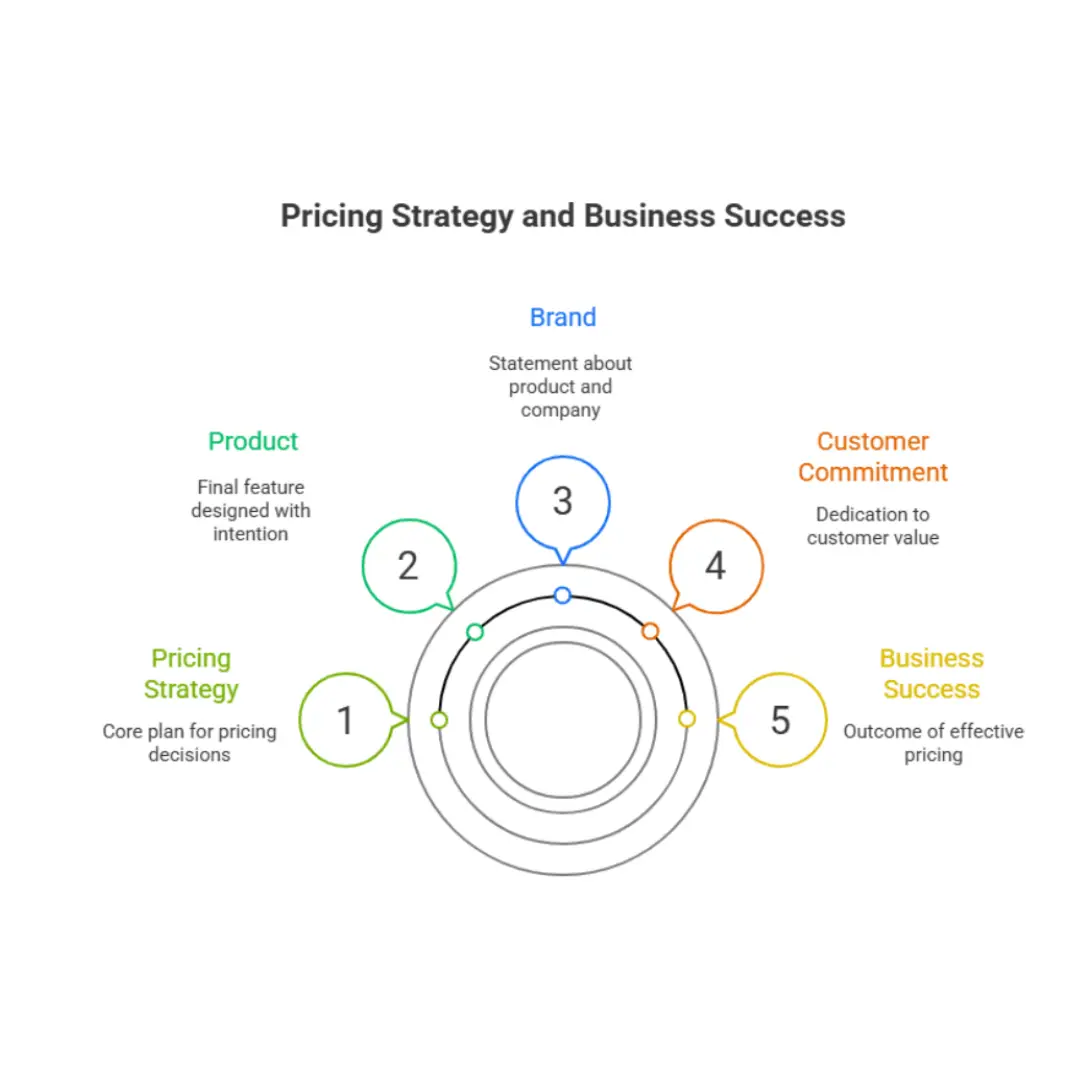
- It Validates Your Product’s Value: If you’ve designed a product that solves a real, painful problem, the right price confirms that customers perceive its worth. Charging too little can ironically make people question its quality.
- It Defines Your Brand Position: Are you a premium, high-end solution or an accessible, value for money option? Your price is a powerful signal that attracts your ideal customer segment.
- It Fuels Your Growth Engine: Revenue from sales isn’t just profit; it’s the fuel for research, further development, marketing, and scaling your operations. A sustainable price ensures your business can thrive long-term.
- It Creates a Psychological Contract: Price sets an expectation. A higher price promises a superior experience, better support, and more reliable performance. You must be prepared to deliver on that promise.
Think of your price as the final, crucial feature of your product one that you design with as much intention as the user interface or the physical materials.
The Foundation: 3 Pillars You Must Understand Before Setting a Price
You can’t build a great product on a shaky foundation, and the same goes for your pricing strategy. These three pillars are non-negotiable starting points.
1. Know Your Costs (Inside and Out)
This is the baseline. If you don’t know what it costs to create and deliver your product, you can’t possibly price it profitably. Go beyond the obvious:
- Fixed Costs: Rent, software subscriptions, salaried employees. These exist regardless of how many units you sell.
- Variable Costs: These scale with production. This includes raw materials, manufacturing, packaging, shipping, and transaction fees (like credit card processing).
- One-Time & Hidden Costs: Don’t forget the R&D investment, tooling costs, product design fees (like ours at Shark Design!), certification fees, and initial marketing spend.
The Goal: Calculate your Cost of Goods Sold (COGS) per unit. This is your absolute floor. Your price must be higher than this to avoid losing money on every sale.
2. Know Your Customer (Their Problems and Their Wallet)
You designed your product for a specific person—now you need to price it for them. Deeply understanding your customer is paramount.
- What Problem Are You Solving? Is it a minor inconvenience or a critical business pain point? The more acute the pain, the more you can charge.
- What is Their Willingness to Pay? Conduct surveys, interviews, or even pre-order campaigns to gauge what your target audience believes the solution is worth.
- What is Their Economic Profile? Are you selling to budget-conscious consumers or enterprise clients with large budgets? This dramatically shifts the acceptable price range.
Pro Tip from Shark Design: During our user research phase for a client’s product, we often include questions about budget and value perception. This qualitative data is pure gold when it’s time to model pricing later.
3. Know Your Competition (But Don’t Be a Slave to Them)
Competitor analysis is crucial, but it’s not about copying. It’s about context.
- Who are your direct and indirect competitors?
- What are their price points? Map out their offerings.
- What is their value proposition? Are they competing on features, quality, brand story, or convenience?
- Identify the Gaps: Where are they undeserving the market? Perhaps their product is cheap but flimsy, or powerful but overly complex. This is your opportunity to position your product and justify a different price.
The Pricing Playbook: 7 Models to Consider for Your Product
With your foundation solid, it’s time to choose a pricing model. There is no one-size-fits-all solution. The best model depends on your product type, industry, and goals.
1. Cost-Plus Pricing
What it is: You take your total costs and add a fixed markup percentage (e.g., Cost + 30% = Price).
Best for: Physical products with predictable costs, retailers, and commodities.
The downside: It completely ignores the customer’s perceived value and the competitive landscape. You could be leaving money on the table or pricing yourself out of the market.
2. Value-Based Pricing
What it is: The price is based primarily on the perceived or estimated value your product delivers to the customer.
Best for: B2B software, services, and products that save time, generate revenue, or solve a very expensive problem.
The upside: This is often the most profitable model. It aligns the price directly with the benefit, allowing you to charge a premium for a premium solution.
Example: A project management tool that helps an agency recover 20 billable hours per month can be priced based on a fraction of that recovered value, not just the cost of servers.
3. Competitor-Based Pricing
What it is: Setting your price based on what your competitors are charging.
Best for: Markets with established, standardized products and high competition (e.g., smartphones, cereals).
The downside: It can lead to price wars and erode profit margins. It also makes you a follower, not a leader.
4. Freemium Model
What it is: You offer a basic version of your product for free, while charging for advanced features, functionality, or capacity.
Best for: Digital products, SaaS (Software-as-a-Service), and apps with a wide potential user base.
The upside: Excellent for user acquisition and building a large funnel. It reduces the barrier to entry.
The challenge: You must design a “premium” tier compelling enough to convert free users. You also need a huge volume of users to make the economics work.
5. Tiered Pricing
What it is: Offering several packages at different price points with different feature sets (e.g., Basic, Pro, Enterprise).
Best for: Serving multiple customer segments with a single product.
The upside: Caters to different needs and budgets, maximizing your market reach. It also creates a clear upgrade path for customers as their needs grow.
Key Consideration: The tiers must be simple to understand and the value must be clearly communicated for each step up.
6. Skimming Pricing
What it is: Launching with a high initial price and then gradually lowering it over time.
Best for: Innovative, cutting-edge products with low competition (e.g., new gaming consoles, flagship smartphones).
The upside: Maximizes revenue from early adopters who are less price-sensitive and eager to have the latest technology.
The downside: It can attract competitors who will enter the market with lower-priced alternatives.
7. Penetration Pricing
What it is: The opposite of skimming. You enter the market with a very low price to quickly attract a large number of customers and gain market share.
Best for: Entering a crowded market or for products where network effects are important (the more users, the more valuable the product becomes).
The risk: You train customers to expect low prices, making it difficult to raise them later without causing churn. It can also be unsustainable if not backed by a long-term plan.
The Psychology of Price: Designing for the Human Brain
People are not perfectly rational economic robots. How you present your price influences how it’s perceived.
- Charm Pricing: Ending a price with .99 (e.g., $19.99 instead of $20). It’s a classic for a reason—our brains tend to round down and perceive it as significantly cheaper.
- The Decoy Effect: Offering three tiers where the middle option is the most attractive. A high-priced “premium” tier can make the mid-tier look like a much better value, steering customers toward your target option.
- Anchoring: Presenting a higher price first to set a mental “anchor.” For example, showing “~~$1499~~ $1399″ makes the $1399 price feel like a great deal in comparison.
- Price Bundling: Grouping several products or features together for a single price that feels like a better value than purchasing each item individually (e.g., a software suite vs. individual apps).
A Step-by-Step Framework to Build Your Strategy
Let’s bring this all together into a practical, actionable plan.
- Define Your Goal: Is it maximum profit, market share, customer acquisition, or clearing old inventory? Your goal dictates your strategy.
- Gather Your Foundation Data: Calculate your COGS. Conduct customer research to gauge willingness to pay. Analyze your competitors’ pricing and positioning.
- Select Your Primary Pricing Model: Based on your product and goals, choose the core model that makes the most sense (e.g., Value-Based for a unique SaaS, Cost-Plus for a simple physical good).
- Crunch the Numbers: Create financial models. How many units do you need to sell at each potential price point to break even? To hit your profit targets?
- Craft Your Tiers and Structure: If using a tiered model, carefully design the features for each tier to guide customers to your desired option.
- Apply the Psychology: Finalize your price points using charm pricing, anchoring, or bundling to enhance appeal.
- Test and Validate: Don’t just set it and forget it.
- A/B Test: If you have an online sales page, test two different price points or tier structures.
- Get Feedback: Talk to potential customers. “At this price, would you buy it? Why or why not?”
- Launch with a Promotional Price: A limited-time offer can create urgency and give you initial traction and data.
- Iterate and Adapt: The market changes. New competitors emerge. Customer needs evolve. Be prepared to review and adjust your pricing periodically. It’s a living strategy.
Common Pricing Pitfalls to Avoid
- The Race to the Bottom: Competing solely on price is a dangerous game. There will almost always be someone who can afford to sell it cheaper. Compete on value instead.
- Setting a Price and Forgetting It: Your initial price is a hypothesis. You must use real-world sales data to validate and refine it.
- Being Afraid to Charge What You’re Worth: Especially for service-based businesses and innovative products, underpricing is a common mistake. It devalues your work and can lead to burnout.
- Making Pricing Too Complex: If a customer needs a calculator and a glossary to understand your pricing, you’ve lost them. Strive for clarity and simplicity.
Price with Purpose
Pricing is not a dark art. It’s a strategic discipline that blends data, psychology, and a deep understanding of the value you provide. By moving beyond a simple cost-plus calculation and treating your pricing strategy as an integral part of your product design, you empower your business to not just survive, but to thrive.
Bottom Line
At Shark Design, we believe a great product is the result of thoughtful design at every stage from the initial sketch and user research to the final price that brings it into your customers’ hands. By following this framework, you can approach your product’s launch with confidence, knowing that your price is designed for success.
Ready to bring your product vision to life with a strategy that includes impactful pricing? Let’s talk. Contact Shark Design today for a consultation.
